
Cooling Water Treatment
Cooling Water Treatment
Theory Training
Tables of Contents
- General properties of water
- Impurities in water
- Hardness and alkalinity
- Solubilities
- pH and Cycles of concentration
- Cooling water treatment
- Corrosion and Scale Inhibitors
- Biocides
- Operation and testing
General Properties of Water
- Some of the properties of water which make it ideal for industrial cooling processes are listed below:
- Water has the capacity to store and transport heat
- Water absorbs more heat per pound than any other inorganic substance
- Water has the following physical properties:
- One pound of water gives up 144 BTU’s upon freezing
- At atmospheric pressure, water freezes at 32 deg F and boils at 212 deg F
- Water is most dense at 40 deg F
- One pound of water, when transformed into steam, releases 970 BTU’s
- Pure water does not exist in nature
- There are two main sources of water, note general differences
- Wells and springs are classified as ground water sources
- Low suspended solids and dissolved oxygen, high dissolved solids including iron, hardness, and alkalinity, and also high carbon dioxide
- Rivers and lakes are classified as surface water sources
- High suspended solids and dissolved oxygen, low dissolved solids including iron, hardness, and alkalinity, and also low carbon dioxide
- Wells and springs are classified as ground water sources
Types of Impurities in Water
- Suspended Solids
- Turbidity
- Finely divided suspended or colloidal matter (clay, silt, dirt, organic matter)
- Color
- An arbitrary standard scale used to measure soluble organic materials in water
- Turbidity
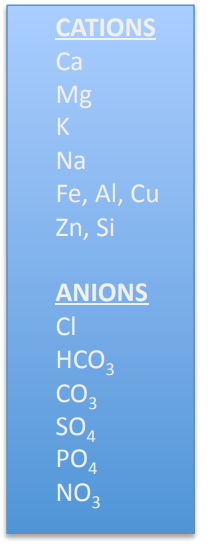
- Dissolved solids
- Dissolved mineral solids
- When rain falls, it scrubs the atmosphere of carbon dioxide
- Carbon dioxide mixes with water to form a weak acid called carbonic acid
- The carbonic acid dissolves mineral solids contained in nature, such as:
- Limestone (calcium carbonate), dolomite (magnesium carbonate), epsom salt (magnesium sulfate), gypsum (calcium sulfate), sand (silica), and common salt (sodium chloride).
- Minerals containing sodium have a relatively high solubility in water
- Minerals containing calcium and magnesium have a relatively low solubility in water
- Dissolved mineral solids
- Dissolved Gases
- Oxygen
- Corrosive to metal at elevated concentrations
- Solubility in water depends on temperature, surface area and pressure
- Carbon Dioxide
- Will form carbonic acid, a weak acid, when dissolved in water
- Carbonic acid dissociates to form bicarbonate and carbonate alkalinity which is pH dependent
- Solubility in water depends on temperature, surface area and pressure
- Oxygen
- Miscellaneous Impurities
- Bacteria that require oxygen and produce carbon dioxide are aerobic bacteria
- Bacteria that do not require oxygen and produce hydrogen sulfide are anaerobic bacteria
- Algae favors exposure to sunlight
- Fungi favors dark secluded areas
Hardness and Alkalinity
- Hardness (calcium and magnesium) and alkalinity (bicarbonate and carbonate) both play a major role in cooling water treatment:
- The weak acid, carbonic acid, that is formed during rainfall has the ability to dissolve minerals in the earth’s strata
- The acid solution is composed of hydrogen, the positively charged portion of the solution (acidic portion), and a negatively charged counterpart
- If the earth’s strata contains appreciable quantities of limestone and dolomite, then two of the primary reactions between the weak acid and the strata will be with the calcium carbonate and magnesium carbonate
- Hardness (calcium and magnesium) and alkalinity (bicarbonate and carbonate) both play a major role in cooling water treatment:
- As the mineral dissolves, both the calcium and carbonate (as well as the magnesium and carbonate), go into solution
- Once dissolved, both the calcium and magnesium (the positively charged portions of the mineral), tend to favor “reverting” back to their natural insoluble state
- When combined with other mineral impurities, calcium and magnesium will preferentially precipitate out of solution and form an insoluble sludge
- The reaction of calcium and magnesium in water with soaps and detergents creates an undesirable sludge which can make laundering difficult. The difficulty or “hard to wash condition” led to the terminology “Water Hardness”
Solubilities
- The common mineral substances can be classified into four categories based on solubility:
- Calcium and magnesium compounds rules of thumb
- Solubility decreases when temperature rises, alkalinity increases, and available carbon dioxide decreases
- Bottom line: hardness salts are more likely to drop out at high temperatures and pH
- Sodium compounds rules of thumb
- Solubility increases as temperature increases. If deposits with sodium are found, it can generally be attributed to extreme concentrations or evaporation to dryness
- Bottom line: Sodium compounds are rarely a problem caused by water treatment
- The common mineral substances can be classified into four categories based on solubility (cont.):
- Silica dioxide rule of thumb
- Solubility increases as alkalinity increases
- Iron and manganese compounds rule of thumb
- Solubility decreases as water alkalinity increases and as the degree of oxidation increases (i.e. oxygen, chlorine, bromine)
- Silica dioxide rule of thumb
- Calcium and magnesium compounds rules of thumb
pH and Cycles of Concentration
- Defined exactly, pH is the logarithm of the reciprocal of the hydrogen ion concentration in the reaction
- A more simple explanation is that pH is a number between 0 and 14 that denotes various degrees of acidity and alkalinity, with neutral water at pH 7. Below 7 becomes increasingly acidic, while above 7 becomes increasingly alkaline
- pH is a very important parameter in water treatment, especially in cooling water treatment. As water is cycled, alkalinity concentrates, so subsequently pH increases, example:

- We call this example as being 2 cycles of concentration, where mineral concentrations, as well as conductivity, are doubled
- At UPMC Shadyside, towers average 5 cycles of concentration
Langelier Saturation Index (LSI)
- A numerical value for the scaling potential of calcium carbonate (CaCO₃)
- The equation is a numerical combination of:
- Total dissolved solids
- Temperature
- Calcium hardness
- Alkalinity
- pH
- A positive LSI is scale forming, a negative LSI is corrosive, and zero is perfect equilibrium
LSI/RSI Calculation
- LSI = pH – pHₛ
- pHₛ = 9.3 + TDS[F] + Temp[F] – (Ca[F] + Alk[F])
Methods of Treatment for High LSI
- Acid Feed
- By reducing pH in cooling water, the equation
LSI = pH – pHₛ
means that LSI will be reduced, therefore calcium carbonate scaling potential is reduced - Proper dilution of acid is critical to contact all points of the system. It is important to equip the system with safeguards if acid feed is lost or inefficient
- By reducing pH in cooling water, the equation
Methods of Treatment for High LSI #2
- Organic phosphonates combined with polymers can withstand LSI to +3.0
- Usually safe to maintain LSI at +2.5
- Another method of controlling LSI is softened make-up, but requires manhours for regeneration and maintenance
Cooling Water Treatment
- Objective of a cooling water treatment program:
- Maintain optimum heat transfer in process equipment and heat exchangers
- Insure equipment reliability and availability
- Minimize operating costs
- Provide predictive treatment recommendations for system operating changes and tower contamination
- Maintain healthy environment in moist areas around perimeter of tower
- Assure system circulation to keep all areas with fresh flow on a regular basis
- Major concern areas:
- Scale: Formation of insoluble deposits on heat transfer surfaces, usually hardness salts on the most critical (or hottest) areas
- High potential with high temperatures, high pH, excessive alkalinity, high dissolved solids, and high hardness
- Corrosion: Loss of metal by reaction with the environment
- Formation at the anode or cathode setting up an “electrical circuit”, or oxidation of base metal
- Fouling: Microbiological and suspended solids deposition
- Algae, fungi, or bacteria depending upon location in system, can act as “the glue that holds deposits together”
- Scale: Formation of insoluble deposits on heat transfer surfaces, usually hardness salts on the most critical (or hottest) areas
Corrosion and Scale Control
Treatment Chemicals
Changing Chemistries Over the Years
- Toxic Nature of Chromate
- Desire to Eliminate Acid
- Desire to Operate at High Cycles
- Economic Pressure
- More Effective Inhibitors
Overview
- Carbon Steel Corrosion Process
- How Chemical Treatments Work
- Treatment Programs: The Last 20 Years
- The Future
Corrosion Process
ANODE
Fe→Fe+2+2e
CATHODE
H₂O + ½O₂ + 2e⁻ → 2OH⁻
Rust Formation
Fe²⁺ hydrated to Fe(OH)₂
Fe(OH)₂ oxidized to Fe(OH)₃
Fe(OH)₃ precipitates
Anodic Inhibitors
Inhibit oxidation of iron
Promote gamma – Fe₂O₃
Precipitates fill voids
Anodic Inhibitors
- Chromate
- Nitrite
- Molybdate
- Orthophosphate
Cathodic Inhibitors
Inhibit Cathodic Reaction
Form Barrier Films
High surface pH causes precipitates
H₂O + ½O₂ + 2e⁻ → 2OH⁻
Cathodic Inhibitors
- Polyphosphates
- Phosphonates
- Zinc
- Calcium Carbonate
Inorganic Phosphates
- Orthophosphate
- Pyrophosphate
- Tripolyphosphate
- Polyphosphate
Phosphates
- 1940’s: Polyphosphate Glasses
- 1950’s -1960’s: Zinc/Poly Glasses
- 1970’s: Phosphate Esters
- 1980’s: Stabilized Phosphates
Stabilized Phosphate
1st Stabilized Phosphate Program:
Dianodic II™
1st Alkaline Stabilized Phosphate Program:
pHreeGUARD™
Calcium Phosphate Inhibition
| Inhibitors | Active Dosage (mg/L) | Percent Inhibition |
|---|---|---|
| 70/30 AA/AM | 50 | < 25 |
| AA/HPE | 17 | > 90 |
| 1:1 MA:SS | 17 | > 90 |
| PMA | 50 | < 20 |
| Polyaspartic Acid (Green) | 50 | < 20 |
| Inhibitors | Active Dosage (mg/L) | Percent Inhibition |
|---|---|---|
| 60/40
AA/AMPS
7‐8
>90
(TRC‐233, AR‐546, CT‐40, Acumer 2100, WB65‐37AS) | 7-8 | >90 |
| AA/AMPS/TBAM (Acumer 3100) | 7-8 | > 90 |
| AA/AMPS/SS (Goodrite K‐798) | 7-8 | > 90 |
| AA/AHPSE | 8 | > 90 |
| 75/25 AA/AMPS | 9-10 | > 90 |
| (TRC‐233i,
AR‐545,
Acumer
2000,
WB60‐45AS) Sulfonated AA Polymer (Aquatreat MPS) | 9-10 | > 90 |
All-Organic
- HEDP/AMP
- HEDP/PBTC
- HEDP/ORTHO
- HEDP/HPA
Halogen Stabilizers
- Cyanuric Acid
- Sulfamic Acid
- Monoethanolamine
Chlorine Tolerant
- BAYER: PBTC
- RHODIA: PMAP
Zinc Products
- Zinc/Polyphosphate
- Zinc/Ortho
- Zinc/AMP
- Zinc/HEDP
- Zinc/PBTC
- With Polymer
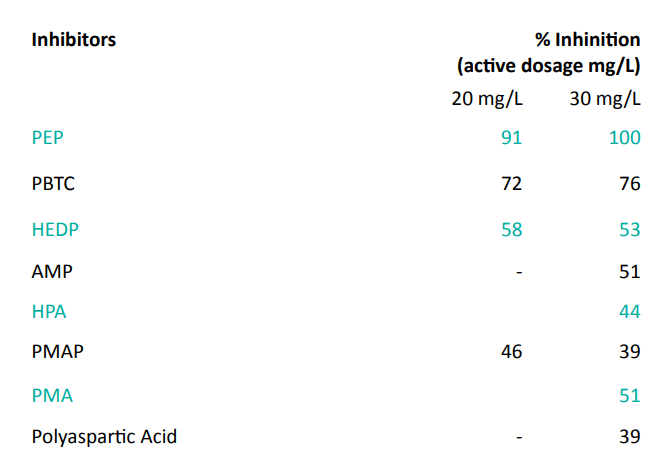
High Calcite Saturation: 240X (LSI=2.8)
Green Chemistry
- Low/Non-Zinc
- Low/Non-Phosphate
- PMAP
Conclusion
- Most Important Development: Improved Polymers
- Polymer of Choice: 60/40 AA/AMPS
- Best High Calcite Saturation Inhibitor: Natcolene PEP
- Future: More Studies Needed for Green Chemistries
Oxidizing Biocides
- Chlorine based
- Not as effective above pH 7.5
- Sodium hypochlorite
- “Bleach” available at 14%
- Chlorine isocyanurate tablets
- Organic chlorine rapid dissolving tablets
- Chlorine dioxide
- Combination of sulfuric acid and hypochlorite
- Sodium hypochlorite
- Not as effective above pH 7.5
- Bromine based
- Effective above pH 7.5
- Stabilized bromine
- 14% bromine combined with sodium hypochlorite
- Bromine hydantoin tablets
- Slow dissolbving fed via brominator
- Bromine isocyanurate
- Rapid dissolving bromine tablets
- Stabilized bromine
- Effective above pH 7.5
Non-Oxidizing Biocides
- Liquid biocides used to supplement an oxidizing biocide program
- Fed via pumps on 7 day timer
- Acts as a poison to kill bacteria/algae/fungi/mold
- WSCP (142L) – algae, bacteria, fungi
- Carbamate – bacteria, sulfate reducers, fungi
- MBT – bacteria, sulfate reducers, fungi
- DBNPA – bacteria
- Glutaraldehyde – bacteria, sulfate reducers, fungi
- Thione – bacteria, fungi
- Triazine, algae
- DGH – bacteria, sulfate reducers, fungi
Operation and Testing
- Molybdate Test
- Add 1.5 mL of tower water to each viewing tube
- Add tap water to 1st mark of each viewing tube(5 mL mark)
- Add one Molybdenum 1 Reagent Powder Pillow to one of the tubes
- Add eight drops of Molybdenum 2 Reagent to the same tube used in Step 3
- Insert the tube from Step 4 insto the right opening of the color comparator
- Place the blank into the left opening, and hold up to natural light
- The control display range is 1.1 mg/L to 1.8 mg/L
- Total and Free Halogen Test
- Fill a viewing tube to the first line (5 mL) with sample water
- Add either total or free chlorine powder pillow to the sample
- For total chlorine test, allow 3 minute reaction time before reading result
- View sample in comparator, control free cholorine 0.1-0.3 mg/L and total chlorine < 1.0 mg/L
- Conductivity:
- Control 1600 – 2000 µmhos conductivity
- Sanicheck Test Kit
- Control < 10⁵ bacteria/mL
Review Quiz
- What is the scale that we are most concerned with in recirculating cooling water systems?
- If the makeup water is 400 conductivity, and the tower water is at 2000 conductivity, what are the cycles of concentration?
- What are ways to control legionella bacteria in a cooling tower?
- Where is hardness most likely to drop out of the water solution in a cooling water system?
- What safety equipment is necessary when handling treatment chemicals?