
Boiler Water Treatment
Boiler Water Treatment
Theory Training
Boiler Overview
- Steam is the basic energy transfer medium.
- Uses include:
- Residential and commercial heating
- Plant process steam
- Plant power generation
- Utility plant operation
- Uses include:
- Critical to the operation of the boiler is water purity.
- The components surrounding a typical boiler system include the following:
- Pretreatment (ion exchange, filtra7on)
- Dearator (combined with condensate return)
- Economizer (heat reuse)
- Steam management equipment (headers, traps)
Pretreatment
- Prepare the water to be boiled.
- Calcium and magnesium salts are most insoluble in the hottest areas.
- Goal of pretreatment:
- Minimize water use or wastage
- Minimize chemical use and reduce overall costs
- Common methods:
- Softening – exchange hardness for less harmful ion
- Lime softening – precipitate hardness
- Filtration – remove solids
- Demineralization – exchange all ions for H⁺ & OH⁻
- Reverse osmosis – remove all ions to concentrate
Softening
- Removes hardness in exchange for sodium.
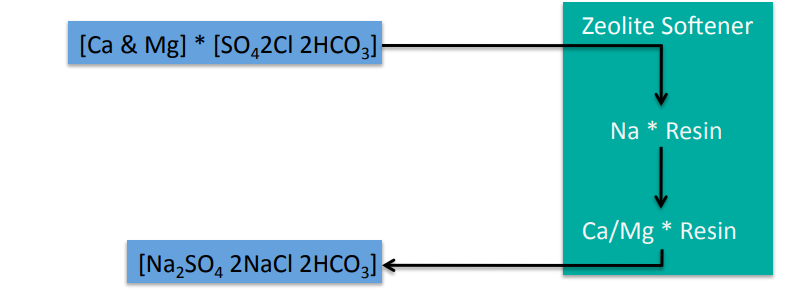
- Regenerate softener with sodium chloride.
- Hardness problems and consequences:
- Iron fouling, organic fouling, poor regeneration, poor control, damaged internals
- Increased deposition in boiler, loss of heat transfer
Deaeration
Based on Dalton’s and Henry’s Laws of gas solubility in water relating to pressure and temperature.
- Too much oxygen in the boiler causes rust:
4Fe₃O₄ (magnetite) + O₂ → 6Fe₂O₃ (hematite) - Can remove this oxygen mechanically or chemically:
- Mechanically
- Increase temperature driving off oxygen
- Increase surface area of water driving off oxygen
- Chemically
- Sulfite reacts with oxygen to make sulfate in water
- Organic acid, hydrazine, DEHA, hydroquinone
- Mechanically
- Combination of mechanical and chemical means is typical.
Boiler System
- Firetube Boilers
- Combustion takes place inside tubes
- Water on shell side – must keep impurities from sticking to the outside of the combustion tubes
- Mud gravity settles to bottom to be blown down, with steam out the top of the vessel
- Common packaged systems
- Watertube Boilers
- Water on tube side, tubes consist of risers and downcomers
- Steam is on top in the steam drum, with deposits collected in bottom mud drum
- Several shapes and sizes exist
- Inspection
Water Treatment Programs
- In a boiler, mineral content in the remaining boiler water is concentrated; ions do not evaporate.
- Cycles of concentration
- Internal boiler water treatment programs:
- Precipitating programs
- Phosphate based programs
- (10Ca²⁺ + 6PO₄³⁻ + 2OH⁻ → Ca₁₀(OH)₂(PO₄)₆)
- Analytical testing procedures and review
- Solubilizing programs
- All polymer dispersant programs
- Analytical testing procedures and review
- Chelant programs
- All polymer dispersant programs
- Chelant programs
- Phosphate based programs
- Precipitating programs
- Solubilizing programs
- All polymer dispersant programs
- Analytical testing procedures and review
- Chelant programs
- Analytical testing procedures and review
Condensate Treatment
- Once steam is used, it is condensed and returned to the feedwater system.
- The more returned, the better:
- Savings in makeup water
- Savings in heat (condensate is ~140°F hotter than makeup)
- The more returned, the better:
- Carbon dioxide in steam condenses and can form carbonic acid unless pH is controlled.
- Neutralizing amines
- Theycondense in selective locations in the condensate system (near, intermediate, and far).
Testing Methods
- Analysis of impurities present in water
- Reporting quantities (Explanation of parts per million)
- Titrations: Alkalinity, sulfite, hardness and chlorides
- Colorimetric Tests
- Phosphate, molybdates
- On-line instrumental tests:
- TDS/conductivity measurement/pH
- For surface blowdown and condensate
- TDS/conductivity measurement/pH
Test Procedures
- Hardness Test – Softener & Condensate
- Measure 100 mL of sample
- Add 2 brass dipperful of Hardness Buffer Reagent (Code 291) and stir
- Add 1 brass dipperful of Hardness Indicator Reagent (Code 290) and stir. If sample is blue, the water is soft
- Add Hardness Titrating Solution drop by drop until color turns blue
- Multiply burette reading by 10 to determine parts per million total hardness
- Control at less than 1.0 ppm
- Sulfite Test – Boiler Water
- Measure 50 mL of sample
- Add 4 drops of Phenolphthalein Indicator (Code 212)
- Add 1 plastic dipperful of Sulfite Indicator (Code 219) at a time and stir between each addition. Continue until red color disappears, then add one additional dipperful
- Slowly add Potassium Iodide-Iodate solution (Code 237). Stir constantly until a faint permanent blue color develops
- Multiply burette reading by 10 to determine parts per million sulfite
- Control at 30 – 60 ppm sulfite
- Neutralized Conductivity – Boiler Water
- To 50 mL boiler water, add 1 mL of Liquid Conductivity Reagent (Code 944) at a time and swirl to mix until colorless
- Measure conductivity on Myron conductivity meter
- Control at 4000 – 5000 µmhos
- Orthophosphate – Boiler Water
- Add 5 mL of filtered sample to mixing tube (Code 152)
- Add Molybdate Reagent (Code 236) to second mark (15 mL)
- Stopper and mix. Add one brass dipperful of Stannous Reagent (Code 239), stopper and mix well
- Place mixing tube in viewing compartment, compare, and record result
- Control at 30 – 60 ppm phosphate
- Hydroxyl Alkalinity – Boiler Water
- Fill mixing cylinder to 25 mL mark with boiler water
- Add 1 mL barium chloride solution, swirl to mix
- Add 2 drops Phenolphthalein indicator, swirl to mix
- Add sulfuric acid reagent one drop at a time, until color changes from pink to clear
- Multiply number of drops times 50
- Control at 200 – 400 ppm (4 – 8 drops) hydroxyl alkalinity
- pH – Condensate
- Use pH meter, control at pH 8.2 – 8.8
Safety Precautions
- Handling boiler water treatment chemicals
- Sampling steam generating systems
- Boiler water sampling
- High purity steam sampling
- Sampling quill explanation
- Condensate sampling
- Cooling coil explanation and discussion
- Boiler house safety concerns
- Analytical testing precautions
- Reagent handling
- Handling precautions
Review Quiz
- Why do we worry about hardness (calcium and magnesium) in the boiler?
- What are the two ways that hardness is managed (in makeup and boiler water)?
- What effect does oxygen have on the boiler?
- If makeup calcium is 1 ppm, and the boiler is running at 20 cycles of concentration, how many ppm calcium is in the boiler water?
- What two pieces of safety equipment should you have when handling chemicals?